

How To Describe Anger In Writing
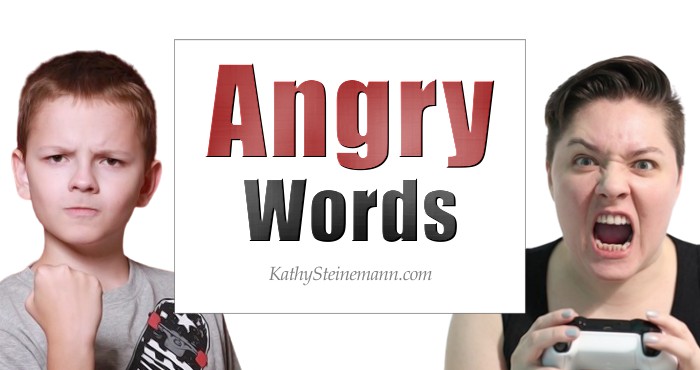
Angry Is an Innocuous Word, Unless It Appears Too Often
Are you a civilized writer?
Sigmund Freud said civilization began the first time an angry person cast a word instead of a rock. Writers cast words. However, those words don't have to include endless repetitions of angry.
A 17th-century proverb provides helpful insight: Actions speak louder than words.
Emotion Beats and Physical Manifestations
An angry character might:
Argue and refuse to listen to other opinions
Attack someone verbally or physically
Ball hands into fists
Bare teeth
Clench jaws
Curse
Explode in strident laughter
Flare nostrils
Frown or scowl
Glare
Gnash the teeth
Lash out at people
Lower eyebrows
Make rude gestures
Narrow the eyes
Point a finger at someone
Poke somebody in the chest
Pound fist(s) on furniture or a wall
Scream or yell
Shake a fist
Speak loudly and/or rapidly
Stand with arms crossed
Stomp
Tense until rigid cord(s) form(s) in the neck
Throw a tantrum
Turn red from collar to roots of hair
Don't Rule Out Similes, Clichés, and Idioms
Many platitudes would be appropriate for dialogue, or you could exploit them as idea fodder. Angry characters might:
Act like a bear with a sore head
Be in a black mood
Bite someone's head off
Blow a fuse/gasket/their top
Come down like a ton of bricks on someone
Demand someone's head on a platter
Eat someone alive
Flip someone off
Flip their lid
Fly off the handle
Get in someone's hair
Get their knickers in a twist
Give someone a piece of their mind
Give someone a tongue lashing
Give someone flak
Give someone the rough edge of their tongue
Go ballistic
Go off the deep end
Go postal
Go through the roof
Harp on someone
Haul someone over the coals
Hit the ceiling
Jump down someone's throat
Lay/light into somebody
Lose it
Pick a bone with someone
Raise their hackles
Rap someone's knuckles
Scream bloody/blue murder
Skin someone alive
Stare daggers at someone
Tear a strip off someone
Vent their spleen
Check These Examples
Example 1
Nora, with an angry red face, told Brandon he wasn't allowed to go to the rave.
Nora's red face shows her anger.
Nora's face turned crimson. She shrieked at Brandon, "You're not allowed to go the rave."
A change from red to crimson emphasizes Nora's emotion, as does the strong verb shriek. Converting narrative to dialogue will engage readers, although many writers would remove the comma after Brandon and replace it with a period to create an action beat instead of a dialogue tag.
Let's create a different version:
Nora flipped her lid. Then she flipped Brandon off. "You're not gonna go to the rave."
This would work for a story written by an adolescent narrator.
–
Example 2
"What do you want?" asked Marla, growing angry.
Does Marla grow angry, or is she already angry? Having characters start or begin actions should be saved for more appropriate scenarios.
Marla's nostrils flared. "What do you want?" she demanded.
Marla's flared nostrils show her anger. Although I recommend limiting dialogue tags, in this case demanded seems more appropriate for anger than its milquetoast cousin asked.
Yet another twist:
Marla went ballistic, and her voice shot up fifty octaves. "What do you want?" I saw steam coming out of her ears . Literally.
This is another example of a young narrator. It sounds like a teenager's commentary. Literally.
Example 3
Terrance walked , angry and scowling, toward the door.
Terrance's scowl shows his anger. However, we could make the sentence stronger without increasing word count.
With a scowl, Terrance stomped toward the door.
This contains the same number of words — but a more graphic account of Terrance's mood.
Or we could try:
Terrance stomped toward the door, eyebrows drawn so close they could have passed for a bushy caterpillar. His eyes flashed. "It's two a.m. Whaddaya want?"
Do you have any doubt that Terrance is angry? And why?
Example 4
Walden's angry dog grabbed the mail carrier's leg .
Unless this is written from the dog's point of view, we can't know its emotions.
Walden's pit bull gnashed its teeth and attacked the mail carrier's leg.
Gnashing teeth show the dog's state of mind. A specific breed well-known for its aggressive nature adds to the intensity, and attacked creates a visual that is superior to grabbed.
A longer variation:
The mail guy beelined it outta there like a bat outta Hell when Walden's dog growled — but he weren't fast enough. That there pit bull chawed on the dude's leg like it were a jerky treat. No lie.
This narrator might be younger, and certainly comes across as uneducated. Do you have any doubt about the dog's anger?
Example 5
The two angry men were quarreling, and they didn't notice a mugger coming toward them.
We can assume that if the men are quarreling, they're angry. Angry could be omitted, or we could attempt something like:
The two men quarreled, voices so loud they set off security alarms, and they failed to notice a mugger slinking toward them.
Loud quarreling shows the emotional state of the men, and slinking provides a better visual than coming.
Another writer might create something like this:
Slinking through shadows, the mugger crept near. Nearer. His targets — two quarreling men — shoved each other, voices growing louder, oblivious to his approach.
Tension builds as readers see the angry men and react to the suspense.
Example 6
Pedro gave the girls an angry look and then walked away.
Let's consider the definition of glare: to stare in a very angry way.
You can probably guess what the first edit of this sentence will be.
Pedro glared at the girls and then stalked away.
Two strong verbs reduce the word count and create an evocative scene.
Or we could add body language:
Pedro clenched his jaw, mumbled an obscenity at the girls, and hobbled away.
Pedro's mumbled obscenity shows his anger. However, he hobbles away. Maybe the girls did something that caused his limp?
Example 7
The angry crowd scared the police chief.
How can the police chief know that the crowd is angry? He's not in their heads.
The deafening roar of the crowd frightened the police chief.
The second example reports the action from the police chief's POV and tells how the crowd makes him feel.
Or we could avoid tell:
The roar of the crowd drowned out the police sirens. Rioters tossed rocks. They pressed forward, squeezing nearer to the police chief with every shouted obscenity. His trembling hands fumbled for his stun gun.
This example shows the crowd's anger and the police chief's fear.
Explore This List of Angry Alternatives
Showing anger via body language or actions usually requires more words than telling. Too much show will slow your story and frustrate readers. If you need to tell, try one of these words:
A and B
acrid, acrimonious, affronted, aggravated, agitated, annoyed, antagonistic, apoplectic, argumentative, bad-tempered, bellicose, belligerent, beside oneself, bitter, blue in the face, boiling, bothered, bristling, brusque, bugged, burning
C to E
cantankerous, caustic, cheesed off, choleric, churlish, confrontational, crabby, cranky, cross, crotchety, crusty, curt, discomfited, displeased, disturbed, dour, embittered, enflamed, enraged, exasperated
F to H
fed up, fired up, fit to be tied, flaming, flustered, foaming at the mouth, fractious, frothing at the mouth, frustrated, fuming, furious, galled, grouchy, gruff, grumpy, heated, hopping-mad, horn-mad, hostile, hot, hot and bothered, hot under the collar, hot-tempered, hurt
I to L
ill-humored, ill-tempered, impatient, in a flap, in a huff, in a state, in high dudgeon, incensed, indignant, inflamed, infuriated, insulted, irascible, irate, ireful, irritable, irritated, livid, looking for trouble
M to P
mad, maddened, morose, nettled, offended, on the rampage, on the warpath, ornery, out for blood, out of sorts, outraged, overwrought, peeved, peevish, peppery, perturbed, petulant, piqued, prickly, provoked, put out
Q and R
quarrelsome, querulous, rabid, raging, rancorous, rankled, ranting, ratty, raving, riled, roiled, rude, ruffled
S
seeing red, seething, shirty, short-fused, short-tempered, smoldering, snappish, snappy, snippy, sore, soreheaded, spoiling for a fight, steamed, steaming, stern, storming, stormy, stroppy, sullen, surly
T to W
teed off, testy, tetchy, ticked off, touchy, truculent, unreasonable, up in arms, upset, uptight, venomous, vexed, vitriolic, waspish, worked up, wound up, wrathful, wroth
–
How To Describe Anger In Writing
Source: https://kathysteinemann.com/Musings/angry/
Posted by: yatestraid1937.blogspot.com
0 Response to "How To Describe Anger In Writing"
Post a Comment